3. Locations
The Continent of Ororos
^865666
Ororos is the third largest continent on Ermis and is home to several major political powers and interests, as well as a plethora of biomes. Dominated by forests, grasslands, and mountains, Ororos provides a wide range of areas to explore. Its southern regions are home to the dense Fǣr Wildes, home to Thalassia, the seat of the enigmatic Fǣr Council. The continent’s heartland is riven by the Ororos mountain range, on the east coast of which lies the major seaport Themérr, an independent city-state known for its maritime prowess and vibrant trade. In the northeast lies Eryth, one of the twin cities of the Dyarchy, and home to several great houses. To the northwest is Xandoros Reach, a harsh and unforgiving landscape of mountains, forest, and plains. Thura, on the borderlands of the Reach, is the last major settlement before the wilderness gives way to the untamed territories of the north. ^ororos-content
::: twocolumns
Eryth
Eryth stands as the first and most prominent city of Ermis, anchored at the northern base of the Spar. Often referred to as the elder sister to Astryth, Eryth boasts greater size and a more uniform landscape surrounding it. The city is home to three influential Great Houses—Orosen, Hyperion, and Valtor—whose political and magical influence extends throughout the Dyarchy.
With a population approaching 300,000, Eryth sprawls across the fertile northeastern plains of Ororos, its grand architecture dominated by sweeping spires and massive stone structures that rise toward the base of the Spar. Unlike Astryth’s terraced construction climbing the mountain slope, Eryth’s layout radiates outward from the Spar’s base in concentric semicircles, each ring housing different social strata and civic functions.
The city’s prosperity derives from multiple sources: control of the northern terminus of the Spar’s transit system, extensive agricultural lands, arcane innovation from House Hyperion’s magical research, House Orosen’s technological advances, and maritime trade with distant Haem territories. As the elder of the twin cities and original seat of power, Eryth maintains significant influence within the Dyarchy despite the establishment of Omerth as the capital.
The climate is milder than Astryth’s, with gentle rainfall throughout the year nourishing the surrounding farmlands. The convergence of coastal winds with the unique magical properties of the Spar creates occasional meteorological phenomena known as “crown storms,” where lightning manifests in circular patterns around the Spar’s upper reaches.
Entering the City
Travelers approach Eryth through several routes. The most impressive is via the Spar transit system from Astryth or Omerth, arriving at the Grand Terminal—an architectural marvel of glass, steel, and enchanted stone that serves as the city’s primary transit hub. Overland routes converge at four major gates in the city’s outer walls, each named for cardinal directions and guarded by members of the Hegemon’s forces.
Maritime visitors dock at Harbor Erythis, a sprawling complex of piers, warehouses, and naval facilities on the northeastern coast. From here, elevated tramways carry passengers and goods into the city proper, offering spectacular views of both the cityscape and the distant blue horizon of the Haem Sea.
All official entry points feature checkpoints where the Watch—Eryth’s law enforcement force—examines credentials, collects visitor taxes, and ensures compliance with the city’s numerous regulations. Unauthorized entry is severely punished, with violators facing imprisonment or forced labor in the agricultural estates surrounding the city.
A Short History of Eryth
According to historical records preserved by House Hyperion, Eryth was founded in the earliest days of recorded history on Ermis, established by settlers who discovered the unique properties of the Spar and recognized its potential. Ancient texts suggest a connection between these founders and mysterious beings called the “Visitants,” though details remain obscure.
The city grew steadily over centuries, its development accelerated through the engineering prowess of Houses Orosen and Valtor, who collaborated with House Xeryth from Astryth to create the remarkable Spar transit system. This technological marvel, completed in the 10th hectochron of Noctant, 110 KD, transformed Eryth from a powerful but isolated city into a vital hub connecting the continents.
The period between the completion of the Spar transit and the establishment of the Dyarchy (1 MYD) was marked by increasing tensions between the Great Houses of both cities as they competed for control of the lucrative trade route. These conflicts were ultimately resolved through the creation of the Dyarchy, which established a power-sharing arrangement between the twin cities while placing ultimate authority in the hands of the Dyad.
Prior to the construction of Omerth in Thale of the 7th decachron of Sylvant, 87 MYD, the Dyad would alternate their presence between Eryth and Astryth. Even after the establishment of Omerth as the capital, Eryth maintained significant administrative functions through its Citadel complex, where representatives of the Arkane, Gnostari, and Hegemon coordinate with local authorities.
In more recent history, Eryth played a critical role during the Second Illithid War, serving as the primary staging ground for the Hegemon’s forces and contributing significant magical innovations developed by House Hyperion specifically to combat the mind flayer threat.
Wards of Eryth
Eryth is divided into six major wards, each with distinct character and purpose:
The Citadel Ward encompasses the base of the Spar and houses the administrative heart of the city. Here stand the offices of the Dyarchy representatives, the Great House headquarters, and the Grand Terminal. This heavily guarded district features the most impressive architecture in the city, with towering spires and massive stone edifices showcasing magical engineering that predates even the establishment of the Dyarchy.
The Arcane Ward adjoins the Citadel to the east and contains House Hyperion’s vast libraries, research facilities, and the prestigious Academy of Hermetic Arts. Luminous spires and floating laboratories define this district, where arcane scholars push the boundaries of magical knowledge under the patronage of Great Houses.
The Merchant Ward occupies the central eastern portion of the city, featuring the Grand Exchange market complex, counting houses, and guild headquarters. This bustling district serves as the commercial heart of Eryth, where goods from across Ermis change hands amid a cacophony of haggling voices and clinking coins.
The Artisan Ward spreads to the south of the Merchant Ward, containing workshops, foundries, and the showcase facilities of House Orosen. Here, innovation blends with tradition as craftspeople develop new technologies while preserving ancient techniques.
The Harbor Ward connects the northeastern edge of the city to the sea, containing dockyards, warehouses, and the naval headquarters. This utilitarian district prioritizes function over form, though recent renovations have added elegant promenades along the waterfront.
The Commons encompasses the residential districts that ring the city’s outer edges, housing the majority of the population in neighborhoods of varying affluence. The quality of housing and infrastructure decreases notably as one moves further from the Citadel, with the outermost areas merging into agricultural estates.
City Government
Eryth operates under the overall authority of the Dyarchy, but local governance falls to the Conclave—a council comprising representatives from each Great House, the Hegemon, the Arkane, and elected officials from the merchant and artisan guilds. The Conclave is chaired by the Mayor of Eryth, currently Lady Magistrate Elara Nyxus, who serves as the Dyarchy’s appointed administrator.
The Conclave oversees municipal functions including infrastructure maintenance, local security through the Watch, tax collection, and regulation of commerce within the city limits. While technically subordinate to the Dyarchy’s representatives, the Conclave wields significant practical authority due to the complex balance of power between the Great Houses.
Enforcement of Dyarchy edicts falls to the Hegemon’s forces stationed in the Citadel, led by Commander Thaddeus Vex. These elite troops maintain a visible presence throughout the city, their crimson uniforms and gleaming armor a constant reminder of the Dyad’s ultimate authority.
The complex interaction between local governance and Dyarchy authority creates a political landscape where ambitious individuals can thrive by navigating alliances and rivalries, but where outright defiance of the established order is swiftly crushed.
Surviving in the City
Visitors to Eryth must navigate a complex web of social expectations and legal requirements. Official documentation is essential; travelers without proper credentials face detention and possible deportation. The Watch maintains regular patrols throughout the city, and their authority increases in the upper wards closer to the Citadel.
Accommodations range from luxurious guest houses in the Merchant Ward to modest inns in the Commons. Prices escalate dramatically closer to the Citadel, with establishments in the outer Commons offering the most affordable options for ordinary travelers.
Magic use is strictly regulated, with all practitioners required to register with the Arkane representatives in the Citadel. Unlicensed spellcasting is prohibited in public spaces, with exceptions granted only for minor cantrips and practical applications by registered guild members. Violations can result in confiscation of magical items, substantial fines, or imprisonment. Similar rules exist for psionic adepts, who are closely monitored by the Gnostari.
The city’s markets offer goods from across Ermis, but visitors should be wary of counterfeits and inflated prices targeting outsiders. Reputable establishments display the seal of the Merchants’ Guild, indicating adherence to standardized pricing and quality controls.
Notable Features
Sites include the Grand Terminal (the magnificent transit hub at the Spar’s base), the Hyperion Athenaeum (the largest collection of arcane knowledge outside of Omerth), the Grand Exchange (a massive marketplace spanning several blocks in the Merchant Ward), the Orosen Innovation Halls (where technological marvels are developed and displayed), and the Harbor Lighthouse (a magical beacon guiding ships to port and serving as a defensive installation).
Holidays & Festivals
Major celebrations include the Founding Festival commemorating the city’s establishment, held during the first week of Auric; the Harmony Celebration marking the formation of the Dyarchy, observed on Voral of the 1st decachron of Auric; the Arcane Exhibition during mid-Thorm, when House Hyperion showcases magical innovations; and the Craftsman’s Fair throughout the final week of Calix, featuring competitions between artisans.
The most spectacular event is the Crown Storm Festival during late Thorm, when the natural storm phenomena around the Spar are enhanced by House Hyperion’s mages to create dazzling displays of magical lightning that illuminate the entire city.
Commerce
Eryth’s economy encompasses diverse sectors, from agricultural production in the surrounding plains to advanced magical research under House Hyperion’s direction. The city serves as the primary northern trade hub for goods traveling the Spar, with substantial taxes collected on all transit.
House Orosen drives technological innovation, producing advanced mechanisms ranging from precision timepieces to automated manufacturing devices. Their workshops attract artisans and engineers from across Ermis seeking to study cutting-edge techniques.
Maritime trade with the territories of Haem brings exotic materials and expertise to Eryth’s markets, while exporting manufactured goods and magical services. Banking houses offer secure financial transactions, with House Valtor’s counting house serving as the de facto central bank for northern Ororos.
The Grand Exchange hosts specialized markets for rare components used in enchantment, technological innovation, and luxury goods. Prices throughout the city generally exceed those in Astryth due to Eryth’s greater affluence and the higher quality of goods available.
Religion
Worship of Er dominates religious life in Eryth, with the faith’s orthodox interpretation strictly enforced by Eranist clergy working closely with Dyarchy officials. The Grand Temple in the Citadel Ward serves as the primary place of worship, its crystal dome capturing and amplifying the stromlight to create impressive visual effects during services.
House Hyperion maintains private chapels dedicated to Er’s aspect as the source of arcane knowledge, while House Valtor emphasizes Er’s manifestation in natural order and mathematical precision. House Orosen’s interpretation focuses on Er’s presence in innovation and creation, though critics suggest their practices border on techno-mysticism rather than true Eranism.
Alternative faiths operate under careful scrutiny, with only the Haem’s ancestral traditions openly practiced outside the Eranist framework due to diplomatic considerations. The followers of Hodos maintain a discreet presence in the outer Commons, their gatherings tolerated so long as they avoid challenging Dyarchy authority or Eranist orthodoxy.
Major Factions and Notable People
The Great Houses
-
Lady Enchantress Cassandra Hyperion: Head of House Hyperion and recognized as the most powerful practitioner of arcane arts in the city. Her cold demeanor and unwavering dedication to magical advancement mask a complex web of political machinations aimed at increasing her house’s influence within the Dyarchy.
-
High Arcanist Daedalus Valtor: Leader of House Valtor, whose combination of elemental magic and engineering expertise has made his lineage indispensable to Eryth’s infrastructure. Behind his calculatingly polite facade lies a ruthless businessman who values profit and status above all else.
-
Galenus Orosen: The technomantic head of House Orosen, whose body incorporates numerous magical enhancements of his own design. His inventions have revolutionized manufacturing and transportation throughout Ermis, though rumors persist that some of his more exotic creations serve purposes beyond mere convenience.
Dyarchy Representatives
-
Overseer Lysandra Korith: The Arkane’s senior representative in Eryth, responsible for monitoring and regulating magical activities throughout the city. Her seemingly gentle demeanor belies an unflinching dedication to maintaining the Dyarchy’s control over arcane practices.
-
Commander Thaddeus Vex: Leader of the Hegemon forces stationed in Eryth, a battle-hardened veteran of campaigns against both Illithid incursions and internal threats to Dyarchy rule. His harsh enforcement of regulations has earned him the nickname “Iron Hand” among the citizenry.
-
Hierophant Marius Lumen: Chief representative of the Erathoi in Eryth, overseeing religious observances and ensuring adherence to orthodox Eranism. His thunderous sermons on the dangers of heterodox thought have made him both feared and respected throughout the city.
City Authorities
-
Lady Magistrate Elara Nyxus: Mayor of Eryth and chairwoman of the Conclave, appointed by the Dyad but maintaining careful relationships with all major factions. Her diplomatic skills have proven invaluable in navigating the complex power dynamics between the Great Houses and Dyarchy representatives.
-
Captain Serena Thorn: Commander of the Watch, responsible for maintaining order and investigating crimes within the city limits. Her incorruptible nature and methodical approach to enforcement have earned her the grudging respect of even the most cynical citizens.
-
Guildmaster Kevan Silverhands: Head of the Artisans’ Collective representing non-house-affiliated craftspeople throughout Eryth. His advocacy for independent artisans often places him at odds with House Orosen’s expansionist policies.
Architecture and Culture
Eryth’s architecture reflects its status as the first seat of power, with grand spires and ancient structures showcasing magical engineering that predates even the establishment of the Dyarchy. The oldest buildings near the Spar feature seamless stone construction that would be impossible to replicate with conventional methods, while newer districts display a harmonious blend of traditional forms with innovative materials developed by House Orosen.
The city’s citizens take pride in Eryth’s status as the “elder sister” of the twin cities, considering themselves more sophisticated and refined than their Astrythian counterparts. Cultural life centers around the celebration of knowledge and innovation, with regular exhibitions of magical research and technological advancement drawing crowds from across Ermis.
Educational institutions thrive under House Hyperion’s patronage, with the Academy of Hermetic Arts attracting the most promising magical talents from throughout the Dyarchy. Less prestigious but equally important are the technical schools operated by House Orosen, which train the skilled workforce required for their manufacturing operations.
Despite the overall prosperity, significant disparities exist between the gleaming edifices near the Citadel and the more modest structures of the outer Commons. The Dyarchy’s emphasis on order and progress manifests in regular urban renewal initiatives that gradually extend the city’s grandeur outward from its center, though traditional neighborhoods sometimes resist these changes to preserve their distinctive character.
Thura

Thura is the last major settlement before the wilderness of the Northern Reach begins. While significantly smaller than the twin cities, with approximately 5,000 inhabitants, it serves as a vital trade hub for the northeastern frontier of the continent of Ororos. The city sits at the edge of Xandor River, with its oldest district built on a natural island connected to the mainland by stone bridges.
The settlement is divided into distinct areas reflecting its growth over time: the Island District housing administrative buildings and wealthy residences; the walled Central District containing markets and essential services; and the more recently developed Outer District spreading toward the surrounding plains and forests. Unlike the twin cities with their grand architecture, Thura’s buildings are primarily functional, with stone foundations supporting wooden structures.
Thura’s prosperity stems from three primary industries: lumber harvested from the Northern Woods, fishing from Lake Xandor, and minerals extracted from nearby hills and mountains. The city serves as a collection and processing point for these resources before they’re transported to Eryth and beyond. As the last outpost before the untamed wilderness, Thura attracts a diverse population of merchants, adventurers, and those seeking to escape the stricter oversight of the Dyarchy.
Entering the City
Travelers typically arrive in Thura via the eastern road from Eryth or by boat across Lake Xandor and down the Xandor river. The southern entrance features a simple stone gatehouse where the Lake Watch checks incoming traffic, though these inspections are notably less rigorous than in the twin cities. The island portion of the city can be accessed via three stone bridges, each with its own checkpoint staffed by guards loyal to Patriarch Vanthos.
A Short History of Thura
Thura was established as a small fishing settlement along Xandor River several kilochrons ago, growing significantly after the discovery of valuable minerals in the northern hills. The settlement gained prominence during the expansion of Dyarchy influence into the frontier regions, serving as a forward operating base for expeditions and eventually developing into a permanent settlement.
The city’s development accelerated after the Four Foot War (circa 245-248 KD), when the Dyarchy established a stronger presence to prevent further incursions from the uncharted north. This period saw the construction of Lakeview Manor and the formal appointment of the first Patriarch as the Dyarchy’s representative.
Despite this official oversight, Thura has maintained a tradition of practical self-governance through the Domen (City Council), creating a unique power-sharing arrangement between local interests and Dyarchy authority. Major historical events include the Great Fire of 289 KD that destroyed much of the original wooden structures, the Battle of Xandor Shore during the Second Illithid War (312 KD), and the construction of the Commercium in 330 KD to regulate growing trade.
Today, Thura exists in a state of tension between its frontier independence and increasing Dyarchy oversight, especially with the recent arrival of additional Hetai forces following renewed concerns about Illithid activity in the Reach.
Districts of Thura
The Island District contains Riverview Manor (the Patriarch’s residence), the Temple of Light (dedicated to Er), and homes of wealthy merchants and officials. The Central District houses the Commercium, the main marketplace, government offices, and the headquarters of various guilds and commercial interests. The Harbor District along the southern shore features multiple docks, warehouses, and facilities supporting the fishing industry. The Outer District, the newest and largest area, accommodates most of the population with varied housing, small workshops, and lesser markets.
City Government
Thura operates under a dual governance system:
The Domen consists of three elected members who represent the city’s major factions:
- Cyanus Tollen: Represents mercantile interests and advocates for expanded trade
- Alkaros the Sworn: Former military commander representing security concerns
- Saran Bulkanos: Voice of common citizens and the traditional values of the Reach
Officially overseeing the city is Patriarch Theomir Vanthos, the Dyarchy’s appointed representative who governs from Lakeview Manor on the central island. While technically holding supreme authority, Vanthos has developed a pragmatic working relationship with the Domen, recognizing that cooperation better serves both Dyarchy interests and local stability.
The Watch, commanded by Captain Darian Marsh, maintains order within the city and patrols nearby trade routes. Their jurisdiction occasionally conflicts with the recently established Hetai garrison under Lieutenant Mykos Renn.
Surviving in the City
New arrivals typically find lodging at one of several inns, with The Old Mill being the most popular. Work can be found through the Logging Consortium, fishing crews, or as guards for merchants and expeditions. While less regulated than the twin cities, visitors should still respect local customs and avoid openly displaying powerful magic or advanced technology without proper authorization.
Weapons (beyond daggers, staves, and the like) are not tolerated in the city. The Watch will force all entrants to the city to give up their arms. Those that will not do so will be barred from the city, and risk arrest and “correction” if they resist.
The Commercium serves as the official center for trade, taxation, and resource management. All significant commercial transactions should be registered here, though many smaller deals occur in the informal economy. Unlike the stricter enforcement seen in Eryth and Astryth, Thura’s authorities tend to overlook infractions unless they disrupt the peace or threaten commerce. In various ways the city is awash with corruption, though its natives think of it merely as how business is done.
Magic use is more tolerated than in the twin cities, though dramatic or destructive spellcasting will draw unwanted attention from both the Lake Watch and Hetai observers. The Circle of Er maintains a modest presence but exercises little control over daily life.
Notable Features
Sites include the Memorial Spire commemorating those lost in explorations of the Reach, The Old Mill (a converted water mill now serving as the most popular tavern), the Black Excavation (partially abandoned mines in the northern foothills), and the Standing Stones (ancient monoliths of unknown origin).
Holidays & Festivals
Thura observes standard Dyarchy holidays with local variations. The Harvest Festival at the end of Calix celebrates the summer logging season with competitions between logging crews. The Lake Festival during Thorm features boat races and fishing contests. The Remembrance Day on Thal of the 9th decachron of Nemb honors those lost to the wilderness and Illithid conflicts. The Winterlight Celebration occurs during the darkest period of Noctant, with lanterns placed throughout the city to ward off the deeper darkness.
Commerce
Thura’s economy revolves around resource extraction and processing. The Logging Consortium coordinates timber harvesting from the Northern Woods, employing hundreds during peak seasons. The fishing industry provides year-round sustenance and export goods. House Orosen maintains mining operations in the northern hills, extracting copper, iron, and unusual minerals unique to the region.
Trade flows primarily toward Eryth via both overland routes and lake transport. The Commercium regulates major transactions, while smaller markets throughout the city handle daily commerce. Crafting industries focus on practical goods rather than luxury items, though skilled woodworkers create sought-after furniture from local timber.
Religion
The official religious presence is the Circle of Er, maintaining a modest temple in the Island District under Elder Illuminator Demetria Lux. Their interpretation of Eranism is more pragmatic than dogmatic, adapted to frontier life. Other spiritual traditions maintain a presence, including a small but growing following of Hodos the Opener operating from a converted warehouse near the harbor.
Traditional beliefs tied to the wilderness persist among longtime residents, particularly those with connections to the Redfoot Clan of Doi’oi. These practices honor local spirits and natural forces rather than recognized deities, and are generally tolerated so long as they don’t openly contradict Eranism.
Tehmérr
Tehmérr stands as the jewel of the central Ororos coastline, a powerful independent city-state renowned throughout Ermis for its maritime prowess and vibrant trade networks. Built where the mighty Tehmér River meets the Vardoun Sea, the city has grown from a humble fishing settlement into a formidable naval power with substantial wealth and influence, though not rivaling the combined might of the Dyarchy’s twin cities.
With approximately 120,000 inhabitants, Tehmérr sprawls across several islands at the river delta and extends onto the surrounding mainland. The city is immediately recognizable by its distinctive terraced architecture, with buildings constructed in concentric rings that rise from the harbor toward the central Azure Citadel. This physical arrangement reflects the city’s rigid social stratification, with each level housing different social castes based primarily on their relationship to the sea.
Unlike the twin cities with their House-based power structures, Tehmérr’s society is organized around sacred lineages claiming descent from eight hero-ancestors who supposedly rose from the depths in ancient times to found the city. These bloodlines form the basis of a complex caste system that governs every aspect of life, from occupation to marriage to religious practice.
The city’s prosperity derives primarily from its dominant position in maritime trade between Ororos and Vardoun. Its shipyards produce excellent vessels, its markets overflow with goods from across all continents, and its navy patrols shipping lanes through the central Vardoun Sea, collecting substantial fees for this protection.
Entering the City
Visitors typically arrive in Tehmérr by sea, passing through the imposing Sea Gates—massive bronze-reinforced barriers that can close off the harbor during storms or attacks. Land travelers approach via the Merchant’s Road from the interior, crossing a series of checkpoints before reaching the Outer Harbor district.
All visitors must register with harbor officials, declaring their business and expected duration of stay. Those of noble birth or with official credentials may proceed directly to appropriate quarters, while commoners must secure a sponsor from among the city’s guilds or temples before being permitted beyond the harbor districts.
The imposing navy of Tehmérr is immediately visible upon approach, with dozens of warships patrolling the harbor and surrounding waters. The city’s famous lighthouse, the Tidekeeper’s Vigil, stands over 200 feet tall at the harbor entrance, its enchanted flame visible for miles even through dense fog.
A Short History of Tehmérr
According to local tradition, Tehmérr was founded when eight hero-ancestors—half-divine beings born of the sea—emerged from the depths to establish a settlement at the river mouth. Historical records suggest a more mundane origin, with fishing communities gradually coalescing around a natural harbor over fifteen centuries ago.
The city gained prominence during the early days of inter-continental trade, when its strategic position made it a natural stopping point for vessels traveling between Ororos and Vardoun. As commerce grew, so did the city’s influence, eventually leading to the establishment of the Sea Dominion—Tehmérr’s naval authority—approximately seven centuries ago.
Notable historical events include the Battle of Broken Waves (circa 240 KD), when Tehmérr’s navy defeated a rival fleet attempting to break its trade monopoly; the Great Purge of 301 KD, when High Pontiff Melekar II executed hundreds of officials for corruption; and the recent Victory of Red Sails (352 KD), when Admiral Xanthos crushed the pirate fleet of the notorious Red Hand.
While formally acknowledging the Dyarchy’s continental authority, Tehmérr has maintained effective independence through careful diplomacy, essential trade partnerships, and such naval strength as to make direct confrontation too costly. The recent alliance with Kavouri, their traditional maritime rival to the east, has created a powerful naval coalition that even the Dyarchy must treat with respect.
Districts of Tehmérr
The city is divided into concentric tiers, each housing different social castes and functions:
The Harbor Rings form the outermost district where foreign ships dock, traders gather, and warehouses store goods from across Ermis. This area houses the Landbound—those who never sail and are considered the lowest social stratum.
The Merchant Rings contain markets, counting houses, and guild headquarters. The Trade Caste resides here, managing commerce but strictly separated from higher castes.
The Artisan Rings house workshops, studios, and the homes of skilled craftspeople. The Craft Caste produces Tehmérr’s renowned goods, including its famous ships.
The Scholar Rings contain libraries, observatories, and schools. The Keeper Caste preserves knowledge and trains the city’s youth according to their predetermined stations.
The Sailor Rings house the elite Seafarer Caste—captains, navigators, and those who command vessels—in comfortable compounds with views of the harbor.
The Azure Citadel at the city center contains the Temple of Eight Depths and administrative buildings. The Tide Priests and Sea Lords—drawn exclusively from specific bloodlines within the Great Lineages—reside here and oversee both religious and civic matters.
City Government
Tehmérr operates under a theocratic oligarchy, with the High Pontiff serving as nominal monarch. The current High Pontiff, Nerenthus III, belongs to the Marazin Lineage and governs through the Council of Tides—representatives from each of the eight Great Lineages who hold specific portfolios:
- The Admiral (military affairs)
- The Harbormaster (commerce and trade)
- The Justiciar (law and punishment)
- The Architect (infrastructure and construction)
- The Chronicler (records and history)
- The Ritualist (religious observances)
- The Diplomat (foreign relations)
- The Treasurer (taxation and finance)
Each councilor manages a bureaucracy staffed by members of appropriate castes. This system has remained remarkably stable despite occasional power struggles, largely due to the shared interest in maintaining Tehmérr’s prosperity and independence.
The recent victory over the Red Hand pirates has strengthened Admiral Xanthos Merevar’s position within the Council, creating tension with High Pontiff Nerenthus III, who fears the admiral’s growing popularity. Meanwhile, rumors persist that Treasurer Lydian Korvas is secretly controlled by foreign interests, possibly connected to Kavouri merchants.
Surviving in the City
Visitors must navigate Tehmérr’s complex social stratification carefully. Each caste has distinct clothing, speech patterns, and permitted behaviors. Crossing these boundaries without permission can result in punishment ranging from fines to imprisonment or expulsion.
Foreigners are generally confined to the Harbor and Merchant Rings unless specifically invited to higher tiers. The exception is visiting ship captains and sailors, who are accorded respect proportional to their vessel and role, in keeping with Tehmérr’s reverence for those showing respect and mastery of the sea.
The city’s laws are numerous and strictly enforced by the Tidekeepers—a police force answering to the Justiciar. Particularly important are regulations concerning proper deference to higher castes, religious observances, and commercial activities.
Magic and psionic use is permitted but regulated, with practitioners required to register with the Temple and submit to occasional inspection. Unauthorized use of powers in public spaces is prohibited, especially anything that might affect shipping or commerce.
Notable Features
Sites include the Tidekeeper’s Vigil (the enormous lighthouse guarding the harbor), the Shipwright’s Guildhall (where Tehmérr’s famous vessels are designed), the Grand Bazaar (spanning several islands in the Merchant Rings), the Temple of Eight Depths (dedicated to the hero-ancestors), and the Azure Citadel (seat of government and religious authority).
Holidays & Festivals
Major celebrations include the Tide’s Turn Festival during the spring equinox, when elaborate boat processions fill the harbor; the Founders’ Day ceremonies commemorating the eight hero-ancestors, held on the summer solstice; the Victory Regatta marking the defeat of the Red Hand pirates; and the solemn Depths Remembrance honoring those lost at sea.
Each Great Lineage also maintains its own ceremonies and observances, typically closed to outsiders. These range from lavish feasts to austere rituals, depending on the lineage’s traditional association with specific aspects of the hero-ancestors’ legacy.
Commerce
Tehmérr’s economy revolves around maritime trade and shipbuilding. The city serves as the primary exchange point for goods traveling between Ororos and Vardoun, particularly between Eryth and Kavouri. Its markets offer exotic items from across Ermis, including Sil artifacts, Haem technologies, and rare resources from the Fǣr Wildes.
The shipyards of Tehmérr produce vessels renowned for their speed and seaworthiness, commanding premium prices throughout Ermis. Artisans create distinctive goods marked by nautical motifs and sophisticated craftsmanship, particularly in glasswork, metalsmithing, and textiles.
Banking houses offer secure transfers between major cities, charging substantial fees for their services but guaranteeing delivery even through dangerous waters. The city mints its own currency—the Thalari—accepted throughout maritime trade routes.
Religion
Tehmérr’s religious life centers on the worship of the Eight Depths—deities associated with different aspects of the sea and the hero-ancestors who supposedly carried their essence. These practices blend with traditional Eranism, with priests claiming that the Eight Depths represent manifestations of Er’s divine nature specifically relevant to maritime peoples.
The Temple of Eight Depths dominates the city center, its eight spires representing each deity/ancestor pair. Religious observances include daily tidal prayers, offerings cast into the sea, and elaborate ceremonies marking lunar cycles and seasonal changes.
The Tide Priests maintain exclusive control over religious practices, claiming unique bloodlines that allow them to commune with the Eight Depths. This spiritual authority reinforces their political power, as important decisions require divine consultation conducted solely through their mediation.
Major Factions and Notable People
The Ruling Elite
-
High Pontiff Nerenthus III: Leader of the Tide Priests and nominal ruler of Tehmérr, a calculating man in his sixties who maintains power through religious authority and strategic alliances among the Great Lineages.
-
Admiral Xanthos Merevar: Commander of Tehmérr’s navy and hero of the Victory of Red Sails, whose popularity with both the military and common citizens has created tension with the High Pontiff.
-
Treasurer Lydian Korvas: Controller of Tehmérr’s vast wealth, secretly influenced by foreign interests connected to Kavouri merchant houses, gradually shifting economic policies to favor certain trading partners.
-
Justiciar Ilyra Naxos: Head of the city’s legal system and commander of the Tidekeepers, known for her strict interpretation of traditional laws and unwavering commitment to maintaining social boundaries.
Commercial Powers
-
Guildmaster Barien Vostrum: Leader of the Shipwright’s Guild, whose expertise makes him influential beyond his official caste ranking. His designs have revolutionized naval warfare and trade shipping.
-
Syndic Maelora Thorne: Representative of the foreign merchants’ collective, primarily advocating for Kavouri interests and strengthening the alliance between the two maritime powers.
-
Harbormaster Kallas Durantis: Overseer of all shipping and trade, whose corruption has allowed contraband to flow through certain channels while maintaining a façade of strict regulation.
Religious and Cultural Figures
-
High Ritualist Seriphon: Senior priest responsible for major ceremonies, whose conservative interpretation of religious texts reinforces traditional stratification.
-
Chronicler Thalia Memnon: Keeper of Tehmérr’s historical records and supervisor of education, subtly working to moderate some of the strictest caste divisions while maintaining the appearance of orthodoxy.
-
Master Artificer Daedin Korros: Creator of Tehmérr’s famous lighthouse mechanisms and other maritime technologies, belonging to the Craft Caste but granted unusual access to higher tiers due to his irreplaceable skills.
Physical Characteristics and Culture
Tehmérrans are physically distinctive among Ermis populations, typically standing taller and more powerfully built than their continental neighbors. Their skin tones range from deep brown to nearly black, with fine red hair and dark eyes being common features. Some Tehmérrans are born with six fingers on each hand, considered a blessed mark associated with the hero-ancestors. At the other extreme are the many sailors with one or another missing limbs – they wear the scars of their time at sea proudly.
Elaborate tattoos mark both caste and lineage affiliations, with specific patterns reserved for particular social positions. These markings are applied during coming-of-age ceremonies and expanded throughout life to indicate accomplishments and status changes.
Society revolves around rigid caste divisions, with the fundamental distinction being between those who sail the seas (valued) and those who remain landbound (subordinate). Even among sailors, strict hierarchies exist based on vessel type, role, and lineage. Intermarriage between castes is forbidden, and even casual interaction is carefully regulated (both formally and informally).
Despite—or perhaps because of—these rigid divisions, Tehmérr maintains remarkable stability and has weathered numerous challenges throughout its long history. The shared pride in the city’s maritime dominance and the prosperity it brings to all castes (albeit unequally) creates a strong communal identity that transcends internal divisions when facing external threats.
:::
\newpage
Thalassia and the Fǣr Wildes
::: twocolumns
Thalassia
Deep within the enigmatic Fǣr Wildes of southern Ororos stands Thalassia, the mysterious seat of the Fǣr Council and perhaps the least understood major settlement on Ermis. Unlike the rigid structures and clear boundaries of human cities, Thalassia appears to grow organically from the ancient forest itself, its buildings seamlessly integrated with living trees and natural formations in ways that confound conventional architecture.
Few non-Fǣr have ever been permitted to enter this hidden city, and those who have returned with accounts speak of constantly shifting pathways, structures that appear to rearrange themselves, and a pervasive sense that the entire settlement possesses a mind, perhaps even a consciousness, of its own. Population estimates remain impossible to verify, though scholars believe several thousand Fǣr make their permanent home in Thalassia, with many more traveling between the city and various enclaves throughout the Wildes.
The exact location of Thalassia remains deliberately obscured, with different travelers reporting wildly different journeys to reach it. Some speculate that the city itself may not maintain a fixed position within the physical geography of Ermis, instead existing in a state of perpetual transition between the material world and other planes of existence.
Approaching the City
There are no known maps leading reliably to Thalassia. Those few outsiders permitted to visit are typically escorted by Fǣr guides who follow seemingly random paths through the dense forest, often traveling for days in patterns that appear deliberately designed to disorient. Some visitors report walking through patches of mist or crossing unusual natural formations before suddenly finding themselves within the city’s boundaries with no clear sense of how they arrived.
The most consistent accounts describe an initial encounter with ancient standing stones covered in spiraling patterns that seem to shift when viewed peripherally. Beyond these markers, massive trees with silvery bark form a natural archway that serves as the primary threshold to the settlement.
What Little is Known
Information about Thalassia’s history, governance, and daily life remains fragmentary and often contradictory. The Fǣr themselves show little interest in documenting their past in ways accessible to outsiders, preferring oral traditions and memory-sharing practices incomprehensible to humans.
The city appears to be administered—insofar as such a concept applies—by the enigmatic Fǣr Council, a gathering of their most ancient and powerful members. This Council reportedly meets in a central clearing beneath a canopy formed by interwoven branches of colossal trees. Their deliberations may last for what humans would consider impractically extended periods, with some sessions reportedly continuing uninterrupted for weeks or months.
Thalassia is known to contain various “districts,” though these do not follow human conceptions of urban organization. Areas of the city are instead defined by natural features, seasonal attributes, or relationships to abstract concepts that outsiders struggle to comprehend. Visitors have described sections where time appears to flow differently, where gravity seems optional, or where colors exist that have no names in human languages.
Notable Features
The few consistent landmarks reported include the Council Grove where the Fǣr leaders convene; the Singing Pools, a series of interconnected bodies of water that produce harmonious tones when disturbed; the Luminous Arbor, where bioluminescent plants and fungi create spectacular light displays at Strom’s Ebb; and the Grove of Remembrance, where the Fǣr commune with ancestral memories through means unclear to outside observers.
The Fǣr Wildes
Surrounding Thalassia and extending across much of southern Ororos, the Fǣr Wildes constitute one of the most mysterious and potentially dangerous regions on Ermis. These ancient forests, misty valleys, and otherworldly groves defy conventional exploration, with landmarks shifting position, compasses failing inexplicably, and time itself seeming to flow inconsistently throughout the territory.
The Wildes represent one of the last expansive regions beyond effective Dyarchy control, maintained as such by both the formidable natural barriers and the active resistance of the Fǣr themselves. While not openly hostile to visitors, the Fǣr permit outsiders only limited access to their domain, typically restricting them to established paths near the boundaries.
Geography and Environment
The environment of the Fǣr Wildes defies easy categorization, containing microclimates and ecosystems that should not naturally coexist in such proximity. Ancient forests of impossibly tall trees give way to crystalline grottoes, which themselves border misty moorlands that transition into flowering meadows where seasons seem to operate independently of the surrounding areas.
Flora and fauna throughout the region exhibit unusual properties, from trees that appear to consciously rearrange their branches to creatures that seem to phase between material existence and something other. Naturalists from the twin cities who have attempted to catalog these phenomena typically return with contradictory observations and samples that inexplicably transform or dissolve once removed from the Wildes.
Water features prominently throughout the Wildes, with countless streams, pools, and waterfalls forming an interconnected network that some scholars believe serves as both a physical and metaphysical circulatory system for the region. Many of these waterways exhibit unusual properties, from reversed flow patterns to water that glows, sings, or temporarily grants strange abilities to those who drink it.
Known Settlements
Beyond Thalassia itself, the Wildes contain numerous smaller Fǣr settlements, though these bear little resemblance to human villages. These communities might consist of dwellings grown directly from living trees, structures that appear only during certain phases of the Strom’s cycle, or habitations that exist partially in alternate planes of reality.
The most accessible of these settlements is Gloaming’s Rest, located near the eastern edge of the Wildes where the forest meets the plains. This small community serves as an occasional trading post where Fǣr exchange exotic materials and crafted goods for specific items from human lands. The settlement materializes fully only during the ebbing hours, gradually fading from visibility as either night or day becomes dominant.
Inhabitants and Culture
The Fǣr themselves comprise numerous subgroups with distinct characteristics and affinities, though they present a unified front when dealing with outsiders. Some appear nearly human but for subtle differences in proportion and coloration, while others exhibit more dramatic variations that suggest connection to elemental forces or abstract concepts.
What little is understood of Fǣr culture suggests a society that places tremendous value on balance, cycles, and interconnection. They appear to measure time differently than humans, with some individuals reportedly living for centuries while maintaining perfect recollection of events throughout their extended lifespans.
Communication with the Fǣr presents significant challenges, as even those who speak common languages often employ circular reasoning, metaphorical references, and conceptual frameworks alien to human thought. Many seem capable of forms of telepathic or empathic communication that transcend verbal language entirely.
Relations with the Outside World
The Fǣr maintain deliberate isolation from the affairs of the Dyarchy and other human powers, intervening only when activities directly threaten the integrity of the Wildes or disrupt what they consider essential balances. The Council occasionally sends emissaries to Eryth or Astryth when necessary, though these representatives typically deliver cryptic warnings or enigmatic advice rather than engaging in conventional diplomacy. Often a Fǣr envoy will visit areas of natural resource extraction, in the hopes of protecting the natural structure of things from what the Fǣr regard as aggressive intrusion.
Trade between the Fǣr and outsiders occurs sporadically and under strictly controlled circumstances. The Fǣr show interest primarily in certain metals, knowledge recorded in specific forms, and occasionally mundane items that hold significance for reasons they decline to explain. In exchange, they offer botanical specimens with unusual properties, crafted items imbued with subtle enchantments, and rarely, guidance through portions of the Wildes that would otherwise prove impassable.
Various human expeditions have attempted to map or exploit resources within the Wildes over the centuries, almost invariably ending in failure. The few that have returned often report encounters with “guardians” that range from massive creatures resembling animated plant matter to phenomena that defy description entirely.
Major Figures
What little is known of the Fǣr Council suggests it comprises entities of great age and power, though their names and specific domains remain obscure to outsiders. A few figures have become known through limited interactions with the Dyarchy and other human settlements:
-
The Watcher – A Fǣr of indeterminate age who appears at significant historical events throughout Ermis, observing and recording in ways imperceptible to others. Recognized by their cloak of continuously shifting patterns that seem to reflect past and future events simultaneously.
-
Lysandros the Boundary Walker – The most frequently encountered Fǣr emissary, who occasionally visits Eryth and Astryth when circumstances require communication between realms. Distinguished by eyes that frequently shift color, they act according to purposes largely unknown to human observers.
-
The Green Mother – A powerful entity rarely seen but often referenced by other Fǣr, reportedly responsible for the vitality and growth patterns throughout the Wildes. Some accounts describe her as indistinguishable from the forest itself, capable of manifesting through any plant life within her domain.
-
The Circle of Seven – A group of Fǣr who specialize in relations with other realms, occasionally permitting scholars or dignitaries limited access to certain areas of the Wildes. Each member appears to embody a different aspect of natural or metaphysical forces.
:::
\clearpage
The Continent of Vardoun
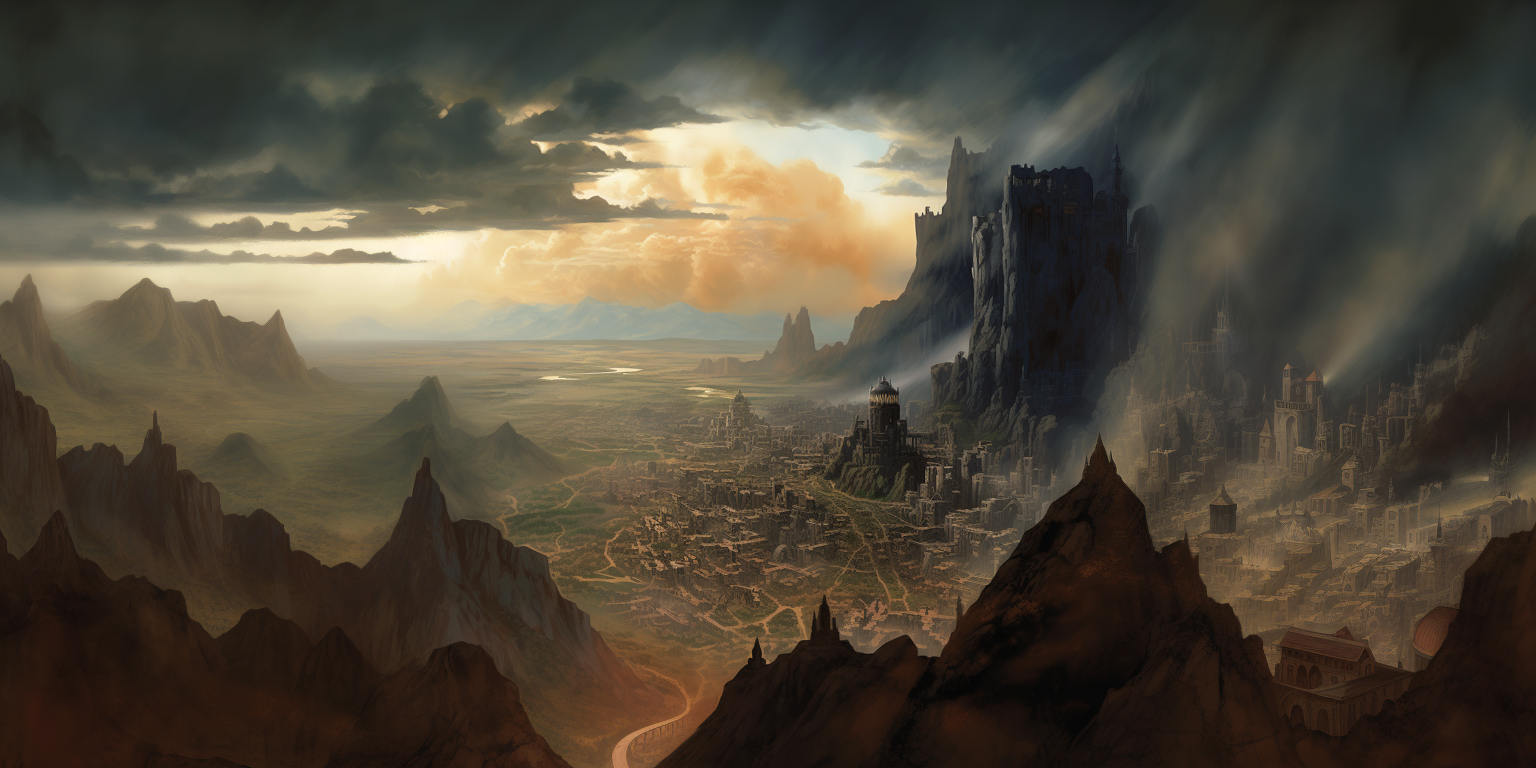
One of three major continents on Ermis. It is home to the Haem and the cities of Astryth and Kavouri. It also hosts the Vardoun mountains that surround the Kypar desert, the home of the Sil.
\vspace{\baselineskip}
::: twocolumns
Astryth
Astryth is one of two major cities on Ermis, sister to the city Eryth. It is the original home of Vires. Astryth is slightly smaller than Eryth but also has a more varied surrounding landscape, encompassing, plains, mountains, desert, and forest. The core of the old city is located at the southern base of the The Spar.
Astryth consists of multiple levels as it carves its way up the foot of the Spar. Lower Extremis, Ward Demos, and part of Ward Sophos are on the lower slope. Ward Aurum, Ward Emporos, and the Citadel, are all on the upper slope of the base of the Spar.
Astryth also has an “undercity”, which is a network of passages and sewers that lead throughout the city. The undercity is also connected to the so-called “underdark” which is a deeper network of caverns and tunnels that lead into the mountains. From both the undercity and the underdark one can find passages leading to the tunnels of the Sil in the northern wastes of the Kypar desert.
Entering the City
Most travelers arrive in Astryth via the network of roads that converge on the city. There are no gates or walls surrounding the city, but there are various checkpoints, and the Watch patrols the major roads, especially Magna Platea (runs east-west) and Via Kyper (runs north-south). The mountain passage of the Spar grants direct access from Eryth, while other roads lead from the surrounding plains, forests, and villages.
A Short History of Astryth
Astryth was founded generations ago (several metachrons) at the base of the Verdoun Mountains. As the settlement grew over time, it expanded across several terraces carved into the mountain slopes.
The accumulation of generational wealth has led to a highly stratified society. City politics and commerce are largely under the control and purview of the two great houses, Tethys and Xeryth. The engineering of the Spar is largely due to the work of Xeryth in Astryth and the Houses Orosen and Valtor in Eryth. Spar transit took nearly a myriachron to engineer and build, but was finally finished in the 10th hectochron of Noctant, 110 KD (Kilochron Diarchian). The success of Spar travel and especially trade brought an increase in conflict between the Great Houses, which was eventually resolved through the establishment of the Dyarchy and the reign of the first Dyad on Voral of the 1st decachron of Auric, 1 MYD (Myriachron Diarchian). Prior to the construction of Omerth in Thale of the 7th decachron of Sylvant, 87 MYD, the Dyad would alternate their presence between Eryth and Astryth. The Citadel was their seat of power, and today still constitutes their administrative presence in each of the cities, with the Arkane, Gnostari, and Hegemon all sharing buildings in the Citadel.
Major events include the founding of the Arkane College Lyceum Miskatonis on Quarn of the 2nd decachron of Vestan, 342 KD, the overthrow of the leader of House Tethys, Mordechai Azhad-Gul during a Strom Surge in Merin, 12 KD, and the election of Chancellor Allisandra Venturi on Thale of the 8th decachron of Orren, 78 MYD. Astryth has endured plagues, famines, succession struggles, and occasional attacks by Scro, Sil, and other creatures issuing from the mountains and desert wastes.
Today the city covers over 35 square miles and houses over 250,000 inhabitants. It remains a key stop for overland trade routes and hosts a thriving community of artisans, merchants, and academics.
Wards of Astryth
The Ward Emporos houses markets, guilds, and shops. The Ward Sophos contains the Collegia Miskatonis, as well as a variety of libraries, manuscript dealers, and purveyors of magic. The wealthy typically dwell in Ward Aurum. Ward Demos, as well as Upper and Lower Exremis largely house workers and the poor. An undercity lies beneath parts of the city, particularly Ward Demos.
City Government
Astryth is governed by the Council of Three - the Chancellor, High Arkanist, and High Inquisitor. These are appointed by the leaders of House Tethys and Xeryth, after several rounds of voting by the other houses and the lower Ward Demos. The Council oversees the bureaucracy, city guard, taxes, laws, and foreign relations. They strive to balance the interests of the four wards.
Surviving in the City
New arrivals should secure lodging in an inn or boarding house, then seek work through markets, guilds, or temples. The lower wards offer cheaper housing but more dangerous streets, so go armed and be cautious at night. Beware pickpockets in the bazaar crowds. The laws of the city are many, and can be complex for newcomers. Punishment of infraction can be quite harsh. At the minimum, newcomers to the city often find themselves quickly facing the choice between payment of a fine and spending a night in one of the city jails.
Magic and technology are also strictly regulated. While many occupants of the city have some sort of facility with magic, typically the public use of magic more significant than that of a cantrip is frowned upon unless one is a clear member of the Arkane order or another municipally-sanctioned organization. This is also true of technology, especially anything that seems like it could be used as a weapon (e.g. absolutely no open display of firearms unless you are a member of the Hetai). Violations of these rules will lead to swift fine and punishment by the Watch.
Notable Features
Sites include the Temple of Vires, Catacombs of the Revered, The Wheel (a gambling parlor), the Blessed Baths hot springs, and many taverns, inns, shops, and warehouses.
:::
::: paracol
Holidays & Festivals
Major celebrations include equinox festivals on the steps of the various temples during Heliodis in Auric and Heliopos in Merin, the masked Revelry of Fools on Fulmen of the 5th decachron of Calix, Viresday honoring Astryth’s contribution to the Dyarchy on Voral of the 1st decachron of Auric, and the Parade of Colors during the Grand Festival on Fulmen of the 10th decachron of Sylvant. Festivals feature feasting, dancing, games, and street fairs. They typically take place on the first Voral of every decachron (week) throughout the hectochron (month).
\switchcolumn[1]
Commerce
Astryth trades in ores, furs, timber, livestock, and crafted goods. Major guilds include Jewelers, Potters, Scribes, and Weavers. The markets offer wares imported over the Spar from Eryth. Coin flows freely in the gambling dens and brothels. The Commercium, at the center of the old city in Astryth, is the main area for trade and evaluation of goods travelling to and from the Spar, as well as to or from the coastal regions beyond the Dunwold or the Western Vardoun range.
\switchcolumn[0]
Religion
Most follow the pantheon of Er. Various temples and shrines dedicated to this pantheon operate in the wards, with the most opulent being in Aurum. However, in part because of Er’s somewhat abstruse nature, and in part because of the seeming infinite variety of Er’s manifestations, there are a number of different groups, cults, and forms of religious praxis that have flourished in Astryth. Among these include the followers of Hodos the Opener, the Order of the Silver Key, and Telios Mechanicus. The Syndicate of the King in Yellow claims devotees in the undercity. Druidic old faiths persist in areas of the city and surrounding countryside.
The Spar
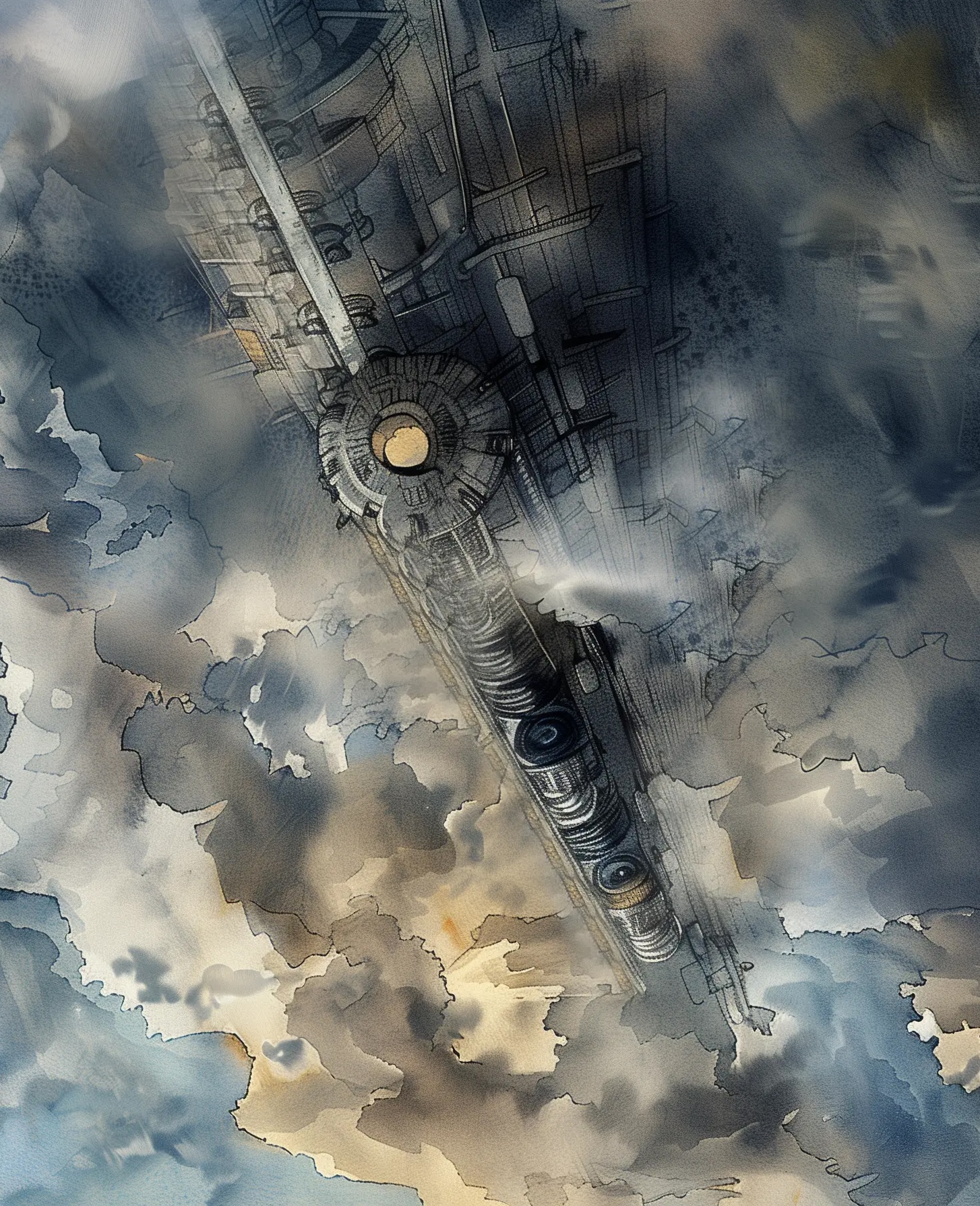
The Spar is the great rock column that spans the diameter of Ermis. It consists of extremely dense rock and is approximately 25 miles in width (it has an irregular cylindrical shape). It is the primary trade way for Ermis.
Omerth is located at the mid-way of the Spar. The Spar itself also hosts the train or funincular that transports most goods between Eryth and Astryth.
\switchcolumn[1]
The Kypar Desert
The desert wastes covering roughly the middle of the continent of Vardoun. They are nested in between the Vardoun mountains and are home to the Sil. The deep desert is home to creatures too dangerous to easily catalogue. There are also rumors of passages in the desert that lead deep into the ground below the surface of Ermis.
\clearpage
\switchcolumn[0]
The Dunwold
A large forest in southern Vardoun. The Dunwold separates the major coastal towns from Astryth and the wider Strythian Plains. The Dunwold is a major source of timber for shipbuilding as well as general construction. Occasional conflicts with the Sylfweards arise due to concern for deforestation.
\switchcolumn[1]
There are roads into the Dunwold, but there is as yet no major road entirely through it.
The Dunwold is made much of in story and rumor. The forest is considered a dangerous place. One does not travel through its heart unprepared.
:::
\vspace{\baselineskip}
\clearpage
Omerth
::: twocolumns
The capital city of the The Dyarchy (and in some ways all of Ermis). It is the seat of autocratic power on the planet. It incorporates both the The Arkanum and the Dunamikon. It is also the residence of The Dyarch.
Omerth is a floating city. It exists on no continent, instead floating at the center of the planet, between the points of the Spar.
Omerth exists solely due to the great technological and magical powers of its wizards and technomancers. Otherwise gravity at the center does not exist, and powerful electromagnetic currents would arc uncontrolled through the area.
The Dunamikon
The Dunamikon is a sacred building in the capital city, Omerth.
The Dunamikon contains two orders of the Dunamis (the power) – The Erathoi, or the Clerics of Er, and The Gnostari, which are the psionic arm of the Dyarchy. Both orders are known for their religious zealotry.
Together, the Erathoi and the Gnostari are the “hand” of the Dyarchy (with the Hetai being its “fist”).
The Arkanum
The Arkanum is a building located at the capital, Omerth housing the governing body of wizards and technomancers serving the Dyarchy. It strictly regulates the use of magic throughout Ermis. It also the source of all the know-how for building the capital city and maintaining it at the center of the Spire.
The Hegemonikon
The Hegemonikon houses the governing members of the Hetai, which is the martial faction of the Dyarchy. Led by the strategic and battle-hardened Hegemon Cassander Voss, they are tasked with enforcing the Dyarchy’s rule, safeguarding its interests, and ensuring stability within its dominion. The Hetai, or the “Red Fist” of the Dyarchy (so named for the symbol worn on their uniforms), are feared and respected for their military prowess, which includes a blend of traditional combat skills and magical capabilities, making them a formidable force in the realm.
:::
\newpage
The Continent of Kra Chora
::: twocolumns
Kra Chora, the largest continent of Ermis, it nevertheless remains shrouded in mystery and largely uncharted by human explorers. Its tundra offers a stark contrast to the more civilized lands of Ermis. Dominated by the forbidding Kra’Aav mountain range, Kra Chora’s landscape is rugged and untamed, with towering peaks and deep, hidden valleys. Nestled within these mountains lies Caer Mynydd, the formidable northern stronghold of the Haem Collective, known for its defenses and isolationist stance. The continent extends into unexplored territories rumored to harbor ancient icy monuments, the creators of which remain a mystery. Kra Chora’s harsh and remote environment, combined with tales of icy wonders, continues to intrigue and challenge the bravest of adventurers and scholars on Ermis.
:::
Created : May 6, 2025