Arcane Space
Everything You Know about Space is Wrong
You might think that space is an infinite void, occasionally broken up by flaming spheres of super-heated plasma, and movement through which depends on propulsion by some chemical or mechanical effort.
Forget all that. It’s wrong.
You can get out of the atmosphere on the back of a Roc; fly between planets in a breathable envelope of air; sail between the so-called “crystal spheres” that surround habited systems on a river of firery energy. The stars are a living thing in some areas, great bowls of fire in others, and in some cases merely pinpoints of light projected onto the inside of a crystal sphere.
CELESTIAL BODIES
The celestial bodies in wildspace are the destinations for adventure. Unlike the orderly physics of our real universe, celestial bodies come in all shapes, sizes, and impossible configurations. Spherical worlds of earth, air, fire, and water exist alongside cubes of solid stone, orbiting rings, shattered asteroids, and sentient planetoids. Gravity may flow sideways, minerals and metals may float as clouds, and physical laws warp and blend between neighboring bodies.
These are more than oddly shaped rocks floating in space - each celestial body is overflowing with adventure hooks and stories waiting to be told. A rogue comet streaking towards a populated asteroid belt; an advanced civilization exiled to the inhospitable surface of a gas giant; a map leading to a treasure world hidden in the cornea of a dead god. The only limit is the DM’s imagination.
Wildspace
Wildspace is the great expanse between celestial bodies, filled with vibrant swirling colors and currents of arcane energy. It appears as an endless void scattered with tiny spheres of light. Though airless and frigid, it teems with magical phenomena and alien life dwelling in the aether streams. Spelljammers sail through wildspace seeking adventure while carefully navigating hazards and phenomena.
Wildspace changes subtly between crystal spheres, though common features exist - ether cyclones that toss ships off course, voidlings that drain magic, breathable air envelopes around ships. A brave explorer might discover forgotten asteroids, derelict spelljammer wrecks, or interplanetary raiders waiting in the dark void between stars. Wildspace is always full of surprises for those bold enough to seek them.
Gravity
Gravity in wildspace originates from objects and fades proportional to their mass, rather than switching sharply on or off. The largest celestial bodies project gravity for thousands of miles. Smaller objects and spelljammer ships use magical helms to produce gravity fields covering their full extent.
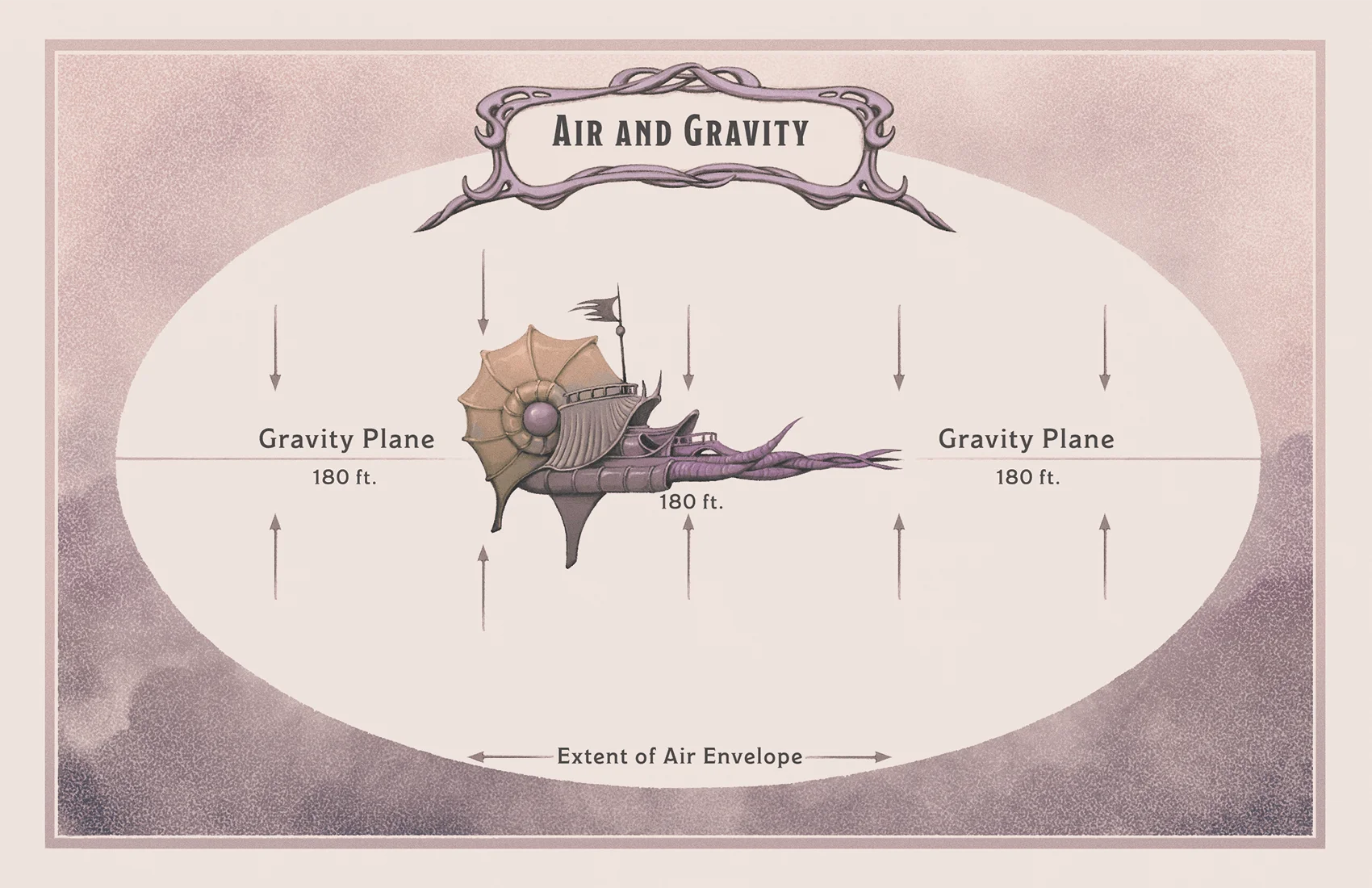
The gravitational pull exerted by an object forms a “gravity plane” aligned to its longest axis. Ships configure their minor helms to direct gravity planes horizontally, causing decks to act as ground. Creatures crossing the vertical edge of a gravity plane will find themselves oriented upside-down on the other side. Shifting gravity fields can flip ships or complicate navigational maneuvers.
Overlapping gravity fields interact in complex ways. The region between two opposing gravity planes creates a neutral zone where objects float unless influenced by other forces. Ships with matched fields can lock together to simplify transfers. But uneven fields can tear ships apart or fling unsecured objects and crew as they intersect.
Pockets of “reverse gravity” and “zero-g” may spontaneously form as gravity eddies and storms warp the aether in wildspace. Navigating these hazards tests the skills of spelljamming helmsmen. Understanding the intricacies of gravity is crucial for survival in wildspace.
Air
Air behaves differently in the expanse of wildspace. As an adventurer ascends, the air thins until only a vacuum remains. But air clings to objects in proportions relative to their mass. A lone traveler carries mere moments of breathable air, while vast spelljamming ships can hold atmospheres lasting weeks.
Within air envelopes, mundane flames burn normally. But in the void of wildspace outside such envelopes, fires are immediately extinguished without the fuel of air. Only magical flames persist, though any object set aflame requires an additional magic sustaining it. In wildspace a careless fireball could asphyxiate a crew as it consumes their limited air.
Spelljammers use air renewal enchantments to maintain breathable atmospheres around themselves. The extent relates to the ship’s gravity plane. Vast vessels skim planetary atmospheres to replenish their air while evading deadly gravity. Smaller ships rely on conserved stores between opportunities to resupply.
When spelljammers meet, their air intermingles, providing chances to trade stale air for fresh. But fouled air causes poisoning, eventually becoming lethal if not cycled. Voidborne raiders siphon air to force surrender, while rumors whisper of void dwellers with the ability to drain ships’ air envelopes completely. To survive wildspace, one must guard their air as closely as the treasure in their hold.
Breathing in Space
A medium creature drags along enough air to last 2 minutes. Should one of these creatures enter wildspace on a 40-foot-diameter boulder, they may have enough air to last months. Generally speaking, a creature larger than medium doubles the air time for each size category above medium while smaller creatures halve it.
For larger objects, like ships, it is easier to calculate air volume in tonnage. Every 1 ton of object is roughly 100 cubed yards of space. This is considered enough air to sustain one medium creature of 4 months under normal circumstances. A 30-ton frigate, therefore, could support its standard d8-sized crew, and a handful of adventurers, for 4 months. Ships loaded with more or less than standard crew use air at rates proportional to the crew on board. A frigate with a crew of 16 would have 2 months of fresh air while one with a crew of 4 could last 8 months.
Air Quality
Air quality around a ship or object can be one of three classes – fresh, fouled, or deadly. These states exist for any creature that can breathe the air. So an atmosphere full of poisoned air could be fresh, fouled, or deadly on top of retaining its poisonous quality.
- Fresh Air: This is fully breathable air usually obtained by entering a planet atmosphere or leaving a port. This lasts for the durations as described above.
- Fouled Air: Stale and depleted. It is humid with others’ breath and smells bad. Fresh air becomes fouled after creature have been breathing it for the provided times. Additionally, air might become fouled from poison, fire, or spells. Air stays fouled for the same amount of time it would be fresh. So a standard ship is fouled for the fifth through eighth months after the initial four. Medium creatures alone have fouled air for 2 minutes after the initial, fresh 2. Players who must breathe within fouled air suffer disadvantage on ability and attack rolls. Crews suffer from the poisoned condition.
- Deadly Air: This air is completely depleted and cannot support life. This air is deadly to those creatures breathing it. Air becomes deadly after its duration as foul air elapses. Anyone who breathes in this atmosphere more than one turn must make a DC 10 Constitution saving throw each turn thereafter or fall unconscious until brought into fresh or fouled air. All creatures who must breathe this air automatically suffer the poisoned condition while breathing it. All open flames die out when exposed to deadly air.
Space Atmosphere Exchange
When celestial bodies meet, their atmospheres interact. The smaller object takes on some of the larger’s atmosphere.
- Size Thresholds:
- Smaller < 1/3 Larger: Smaller adopts larger’s atmosphere.
- 1/3 ≤ Smaller ≤ 2/3 Larger: Both share larger’s air, -1 week.
- Smaller > 2/3 or equal to Larger: Better air is shared.
- Example: If a frigate (12 weeks fresh air) joins a ship with 1 week of foul air, both get 6 weeks of fresh air.
Creature Size Effects:
These rules apply to creatures too. Creatures of different sizes adjust as follows:
- Medium = Medium: Equalize.
- Medium = 2/3 Large: Medium adopts large’s air.
- Small = Huge: Small adopts huge’s air.
Air in Phlogiston and Wildspace:
Air behaves similarly in both Phlogiston and wildspace. In hazardous air or its absence, creatures enter suspended animation. They turn grey and stone-like until rescued and exposed to air.
Consequences of Rescue:
Rescues in wildspace aren’t always benevolent. Pirates seize valuables and discard bodies. Neogi and Mindflayers enslave these victims.
Temperature
Due to the activity of the planets, the spheres, and various gates to the plane of elemental fire, temperature in wildspace is not typically a problem for adventurers. The ambient temperature in most space is about the same as a moderate spring day in the temperate regions of most worlds.
Some crystal shells, however, have surprisingly higher or lower temperatures, and those should be noted on any star chart worth reading. A shell that is little more than an opening into the plane of elemental fire will have a higher temperature than one without any such openings. Krynn space has a very low natural temperature (about 16 degrees fahrenheit) and is plagued by small, lethal clouds of ice particles.
The phlogiston maintains a similarly mild temperature, but with the added danger of explosive fire, as described above. There are no seasons in the phlogiston or wildspace. Of course, as a ship approaches a star, the temperature increases. Landing on a body of fire creates problems similar to entering the elemental plane of fire. A water body could conceivably be cold enough to be nothing but a ball of ice.
Aether Currents
Shimmering rivers of aether energy flow from wildspace around planetary bodies, providing paths for spelljamming ships to traverse. Without the assistance of these currents, escaping the gravity wells of planets and moons would be impossible.
The currents act as celestial highways, permitting access to the worlds they touch. Control of these aether rivers often determines political and military dominance on the planets linked by them. Just as sailing vessels rely on port cities, spelljammers require planets with aether currents.
Yet catastrophe can shift the flows, cutting off worlds from the astral routes. Currents may weaken, strengthen, split, or disappear entirely for reasons not fully understood. The celestial rivers have minds of their own, making the spelljammer’s life one of constant vigilance. What was once reliable may next day become blocked, forcing long detours or challenging gravity climbs.
Clued-in captains guard their astromantic charts of eddies and aether weather. Those who master the currents thrive, while the unwise find only gravity’s death grip awaiting at the end of depleted rivers. The currents giveth and taketh away - maximizing their gifts and avoiding their threats is the spelljammer’s craft.
Time
Time is a constant in a wildspace system. It is also a constant in the phlogiston. So a day = 24 hours in one wildspace system typically elapses the very same way in another system, as well as in the phlogiston that contains both. However, while time is constant throughout the firery sea, it is possible that some wildspace systems will function differently, and that characters will suffer time-dilation or expansion when traveling through those systems. Traveler beware!
The Phlogiston
Passing through the porous membranes of “crystal spheres”, spelljammers enter the vast expanse of the phlogiston. Known as the “flow”, the “astral sea”, or the “rainbow ocean”, the phlogiston appears as a limitless rainbow haze flowing around the crystal spheres.
The phlogiston permeates wildspace but repels against aether, creating bubble-like crystal spheres where the two interact. It has a dreamlike quality, with colors swirling through the envelopes of ships without replacing their air. Distances become obscured as if in fog, and strange psychic visions manifest.
The flow is highly flammable, immediately detonating any exposed mundane flames with explosive force. Attempts to weaponize it fail as it dissipates past sphere thresholds. If ignited within a sphere, it could set off a cataclysmic chain reaction, so its volatility is both blessing and curse. Any flame brought into it or ignited within the flow immediately explodes and subsequently extinguishes. The explosion increases both the radius of the effect and the damage by 3 times.
- Match: 1 fire damage; 2’’ radius
- Candle: 1d6 fire damage; 4’’ radius Lantern: 3d6 fire damage; 1’ radius
- Oil Flask: 3d6 fire damage; 3’ radius
- Cooking Fire: 4d6 fire damage; 10’ radius
- Gunfire: 2d6 fire damage; 2’ radius; shot misfires
Combustion occurs immediately. For instance, trying to light a candle is impossible as the match explodes as soon as it ignites. Spells like Fireball explode as soon as the flame mote appears. As a result, ships traverse the Phlogiston in darkness, snuffing out all flames prior to entry. Fortunately, the Phlogiston itself emits radiant light, illuminating a ship’s outer decks. In the inner chambers or eerie Dark Regions, cold luminous sources such as glowing moths, mushrooms, fireflies, or magical lights are employed—unless the crew possesses natural darkvision.
Perhaps most curiously, the phlogiston disrupts connection to the Inner and Outer Planes while within its rainbow haze. Gods hold no influence here, nor can planar magic draw beings across its boundaries. It is an insulating medium, isolating crystal spheres in the cosmos.
Currents in the sea of phlogiston provide navigable flows for spelljammer ships. Skilled captains ride these astral rivers between spheres, much as mariners traverse tradewinds on the oceans. However, the flow does alter in its course from time to time, perhaps due to some yet as unknown force(s). As a result, navigation in the astral sea is inherently risky and more of an art than a science.
Summary
- Celestial bodies
- Can be any shape, element, composition - not bound by real physics
- Gravity direction always “pulls down” but isn’t bound to physical shape
-
Orbits and inter-body physics don’t adhere to actual astrophysics
-
Wildspace
- Is the void between celestial bodies - airless and filled with magic
- Can vary subtly between different crystal spheres
- Is home to ether phenomena, space-dwelling creatures, hazards
-
Holds adventure seeds like spelljammer wrecks, hidden bases
-
Gravity
- The plane is aligned to the object’s longest axis
- Crossing the plane flips orientation upside-down
- Overlapping fields interact in complex ways
-
Regions of strange gravity provide hazards
-
Air
- Persists around objects proportionally to their mass
- Magical flames burn in a void; mundane flames do not
- Ships can use magic to maintain fresh air envelopes
- Stale air causes poisoning, eventually becoming lethal
- Void raiders weaponize air depletion during attacks
-
Is the essence of life in the void, guarded closely
-
Aether currents
- Act as celestial highways for planetary access and control
- Can shift over time, forcing new routes to be found
- Mapping eddies and weather aids navigation
-
Mastering the currents is key to thriving in wildspace
-
The phlogiston
- Is a vast expanse permeating the space between wildspace systems
- Repulsion with aether creates “crystal sphere” bubbles
- Is highly flammable, detonates mundane flames
- Disrupts planar magic and cuts off gods
- Currents provide navigable flows
- Isolates and insulates each system as a separate cosmos
- Is like exploring open ocean between islands
Created : October 29, 2024